Did you ever wonder why in English the word tree is used to refer to this mental image?

Or why in French the same mental representation is named arbre? How is that the word crown can refer to a person (the Queen of England), a royal headpiece, and a synthetic cap used to repair a broken tooth? And most interesting is the fact that in each of these cases, the phonological form, or sounds of the words do not in any way contribute to the meaning of the actual image or mental representation. The sounds /h/ /æ/ /t/ are not related in any way to the meaning of hat. The discipline of semiotics is the framework for bringing clarity to these types of questions.
The first ‘linguist’ to write about the semiotics was Plato, who attempted to grasp and explain the arbitrary relationship between meaning and its shared representation.
What is Semiotics?
Semiotics is the study of the relationship between words and their meaning, or the study of linguistic signs and mental images they represent. Ferdinand de Saussure, a French linguist, is considered the father of modern semiotics, and semiology. He claimed that there are two main components that make up the linguistic sign: the signifier and the signified.
“A sound pattern is not a physical sound but the mental impression experienced by the senses and based on past experience, a representation of our sensory impressions.”
(Saussure 1983, 66; Saussure 1974, 66)
The Sign, Signifier, and the Signified
Signs are the conduits by which an individual interprets reality, the real world in which s/he lives. Signs can be words, or meta-linguistic elements such as a siren signaling an ambulance, or a dark funnel cloud signaling a tornado. These signs do not bear meaning in and of themselves but are associated with meaning assigned to them by users/speakers of any given language through their experience with them.
For example, why is it when a friend suggests going to a movie, the concept of a circus doesn’t come to mind? This may seem like an unintelligent question, however there is a scientific response.
So let’s break this down.
The sign is composed of the signifier and the signified.
signifier + signified = sign
The signifier is the word or image used to represent the concept it stands for, such as the image and the phonological form ‘tree’, /tri/.
The signified is the concept, the idea represented by the signifier. This is the meaning that has been assigned to the signifier by a speaker of English who has experienced the reality of a tree. This experience, or episode of contact with or acquired knowledge of a tree is stored in the lexicon as a concept with grammatical properties (noun) and semantic information (grows tall, has leaves, bears flowers and fruit, etc.).
Together, these two components make up a linguistic sign, or a unit of meaning represented and recognized by speakers/users of English.
The signifier can elicit the signified, or vice versa. When looking at a tree (image), the concept is elicited. When thinking of a tree, the image or word is elicited.
Another example is the sign ‘dog’.  The signifier as a phonological form, /dɔg/ represents the concept of a ‘furry, 4-legged creature that barks’. The same holds when you see the physical representation of dog, the ‘furry, 4-legged creature that barks’ and immediately associate the word, or phonological form, /dɔg/ with it.
The Relationship between the Sounds and Concepts
There are two principles that describe the relationship between signifier and signified.
Principle 1: The Arbitrary Nature of the Sign
Across languages, concepts are assigned specific phonological forms, or signifiers. However, there is no connection between the sounds and the concept. The sounds of a word to not contribute to its meaning. There is no inherent relationship between the sounds /t/ /r/ /i/ and the physical or mental image of a tree. This is referred to as the arbitrariness of the sign.
The relationship between the signifier and the signified is created within the context of a culture. In a sense, the sign is a result of what speakers of any given language decide it to be. Once a visual or phonological form has been assigned to a concept, it becomes a lexical item, stored in the lexicon and ready for use.
There are, however, exceptions to Principle 1. Take, for instance, the onomatopoeia. These are words in which the quality of the sound invokes or imitates meaning or sounds in nature. This can occur at a suggestive level in which a word-form can elicit meaning due to the contour of sonority. The French word for ‘whip’, fouet, conjures up the image of an item being constrained and then released as it passes through air, by the initial articulation of a strident sound /f/ releasing into an open vowel sound. True onomatopoeic words imitate a real sound such as the word ‘oink’ is used to demonstrate the sound of a pig. Interjections are spontaneous word-forms that express a deep emotion such as when a person cries ‘ouch’ as the result of pain. These types of words are very different between languages.
Principle 2: Linear Nature of Signifier
The signifier is a linear sound pattern that is realized as a measurable span of time. Individual sounds are strung together as a linear chain that takes on a concrete phonological form. The pattern or chain of sounds in any particular order identifies only one concept.(For a discussion on homophony, please refer to the tutorial What is Semantics.) For instance, when the order of sound symbols is altered, so is meaning.
Example:
stop (v.) to come to an end; cease to happen
If the same 4 graphemes are strung together in an alternate order, the meaning changes.
Example:
post (n.) long sturdy piece of timber or metal set upright in the ground and used to support something or as a marker
The alternation of the order of the sounds creates two unique and unrelated concepts.
Or, two words can be identical in all sounds except for one. These sets of words are referred to as a ‘minimal pair’. When one sound is exchanged for another, the meaning or concept changes.
Example:
/steyk/ ‘steak’ (n.) high quality portion of beef taken from the hindquarters of the animal.
/stɪk/ ‘stick’ (n.) a thin piece of wood that has fallen or been cut from a tree.
In this example, when the vowel sound is changed from /ej/ to /ɪ/, the mental representation changes.
Structural Analysis and Semiotics
Discourse analysis is dependent upon the relationship between the signifier and the signified. Structural and pragmatic semiotics provide a framework for examining and identifying constituent units of meaning within a semiotic system and the structural relationships between them.
Semiotic systems are constructed according to shared understandings and past experiences based on culture, region, or even family. To share meaning, all members of a conversation must have experienced the sign similarly.
Semiotic analysis focuses on concepts such as, why one sign is used in discourse rather than another and the effects of alternation. Meaning can differ when the sign undergoes a syntagmatic or paradigmatic alternation. These two categories are often explained as axes.
The syntagmatic axis shows how the signs are ordered in a sentence while the paradigmatic axis is concerned with substituting a word for another.
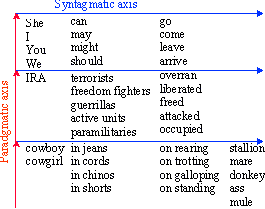
The axes work as a formula, with the syntagmatic showing a “this-and-this-and-this” relationship and the paradigmatic concerned with selection, such as “this-or-this-or-this”.
We can analyze relationships between signs by looking at each axis. The paradigmatic axis represents how substituting one word for another changes meaning. For example, English speakers know that “The boy cried” is different from “The man cried” which is still different from “The man sang”.
The syntagmatic axis shows how a change in word order will result in a change in meaning. English speakers know that the sentence “John loves Jane” has an entirely different meaning from “Jane loves John”. Syntactic constraints of English specify that, in deep structure, the noun preceding the verb is the subject and the one following the verb is the object thus exchanging one for the other gives two readings.
Denotation and Connotation
The denotation and connotation of words are terms describing the relationship between the signifier and signified.
The denotation of a sign is widely agreed upon, whose interpretation is based on shared experiences by a societal group. The connotation is the subconscious meaning associated with a sign. This additional level of meaning can be based on personal experience, or shared by a cultural group. Connotations are the subjective or creative aspect of a concept ascribed to a sign that move beyond the ‘dictionary definition.’
For example, most Americans will make associations between fast cars and young, carefree (and perhaps reckless) men. Thus the connotation of fast cars has been attributed meaning based on a general experience shared by a society.
There is much more to know about semiotics and how it is used in the realms of advertising, law, journalism, and many other areas.
For a more comprehensive treatment of semiotics, click here. http://visual-memory.co.uk/daniel/Documents/S4B/sem05.html
Weller, L. Aronow, R.
Return to Introductory Topics in Linguistics Tutorials


