Memory
Human beings are born with a complex, interrelated system for categorizing and storing every event experienced throughout life. Audio, visual, sensory, and emotional information is integrated, yielding images that are linked to lexical items as events. These are stored in memory.
Not all information is equally easy to recall, since different types of events are stored in different parts of memory, based on significance.
The most current and widely accepted model of memory consists of three general stages: sensory (events that are experienced in real time), short term (which holds a limited amount of information for a limited time period), and long term (which stores events and is composed of layers of levels, based on the nature of the input.
As an event is experienced, neurons are fired, encoded, and stored in the area of the brain responsible for the corresponding type of information. During a memory search (lexical retrieval), encoded neurons are activated in order to reconstruct the past event.
Lexical retrieval and discourse comprehension are highly dependent upon both short-term and long-term memory. Studies in memory give insight into:
- Lexical storage and retrieval
- Categorization of lexical items
- Pathways of retrieval
Levels of Memory
Sensory memory (SM) involves the storage of sensory ‘events’, those that are perceived by any of the five senses in real time. SM is the shortest type of memory, such that sensory information may only be retained for .2 to .5 of a second, since it is quickly replaced by subsequent input. Furthermore, SM has no rehearsal component so stimuli cannot be stored.
Unless intentionally ignored, sensory information is processed automatically. This is why we sometimes experience ‘sensory overload’. This occurs when our senses are bombarded with too much incoming sensory information. Instead of processing everything, we either select what we want to experience, or abandon the source of the overload and shut out all perceptions. When our senses receive a manageable amount of stimuli, one of three processes can occur. SM can deliberately disregard information such that it disappears, or perceive information, at which point it will either decay (be quickly forgotten). Perceived information that receives attention or focus will move on to short-term memory.
Visual stimuli are processed by the iconic memory, aural by echoic memory, and touch by haptic memory. Memory associated with taste is processed by the ‘taste’ cortex, whereas smell or odor memory seems to be in a class of its own. This storage of this type of stimuli are processed by the olfactory bulb and olfactory cortex, which are very close to areas of the brain involved in memory. This most likely accounts for why we remember smells so vividly, and why certain odors remind us of places, people, and experiences.
Short-Term Memory
Information in SM that receives our attention is moved along to short-term memory (STM). STM holds information recently processed, for relatively immediate use and is limited in terms of the amount of information it can store at any given time. Its job is primarily to keep information active and readily accessible.
In other words, STM can be described as a finite amount of temporary, limited storage space where sounds and words are held while sentence processing takes place. So ,when you are listening to a sentence, you need to ‘store’ the first few words while you process the rest. This is also where information is stored during any learning process. Initial information, i.e., such how to draw a syntax tree, must be stored so that subsequent material, i.e., the components of a noun phrase, can be related back to earlier input. This is why some students take notes. Since STM holds a limited amount of information, new stimuli will replace the older such that one forgets what was said 5 minutes previously.
Miller (1956) showed that humans can remember 5-9 chunks of information at a time. STM is used up more quickly if the processing system is doing too many tasks at once, or if one overly demanding task is being performed, like trying to memorize a lengthy list of items. STM does not store complete concepts, but holds the most important information readily available. In the event that this is not needed immediately, the stimuli will move to long-term memory.
PET scans show evidence of separate components of STM as different areas are activated during different tasks.
Working Memory
Working memory (WM) is the fundamental component of STM, so much so, that these two terms are often used interchangeably. WM is often referred to as the ‘search engine’ of the brain. It is characterized by four crucial components. WM operates over a matter of seconds, it provides temporary storage for incoming stimuli, it is the holding place for information that receives the most focus, or attention, and it is the component of the brain where information is manipulated.
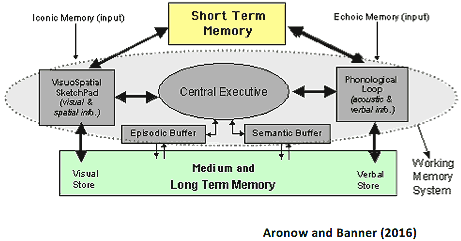
In response to Atkinson and Shiffrin’s (1968) multi-store model of memory, Baddeley and Hitch (1974) developed a model of WM composed of 3 sections in which the central executive controls the two ‘slave systems’: the phonological loop, and visuo-sketchpad.
The Central Executive is located in the frontal cortex and handles higher-level cognitive tasks. Its functions include extracting, holding, and coordinating audio and visual representations during the processes of perception, comprehension, and reasoning. Incoming information received from its ‘slave systems’ is temporarily stored as coherent, episodic instances that can be retrieved and updated.
The Central Executive also plays an important role in coordinating retrieval by directing attention to relevant information, and suppressing irrelevant information
The Slave Systems
The Phonological Loopconsists of two components that maintain and rehearse acoustic input.
Audio stimuli (speech sounds) enter the phonological short-term store, and then move to the articulatory rehearsal component where they are refreshed through repetition or ‘rehearsal’. The memory traces of sounds temporarily stored here are reactivated as needed. For instance, as you process speech (production and perception), you are constantly monitoring all sounds that belong to the words and phrases being formed. Evidence for these components lie in the fact that both speakers and listeners often catch themselves, or others producing speech errors, at which point reactivation occurs in order to retrieve the intended speech sounds.
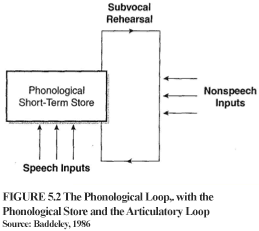 Evidence for the Phonological LoopBaddeley et al. (1975) conducted a study in which participants were asked to say words out loud that had nothing to do with the list of words they were trying to recall. This showed that when two sources of unrelated input are being processed, the articulatory rehearsal process was impeded, resulting in the decay of memory traces in the phonological loop.
Other studies have shown that the recall of a list of similar sounding words takes longer than words that sound different from each other. This is due to the fact that sounds rehearsed for one word may be rehearsed as if they belonged to another. In this type of scenario, the idea or concept (semantic content) is not lost; information is lost at the sub-vocal rehearsal component of the loop.
The Visual Spatial Sketchpadretains and processes visual and spatial information by means analogous to the phonological loop; a short-term store, the inner scribe, refreshes visual and spatial representations through rehearsal. It stores information accumulated visually (shapes, colors, location, speed, etc.). The visual cache or storage occurs in the occipital and visual cortex. Spatial rehearsal takes place in the parietal lobe. Logie (1995) posited that information is maintained by a spatial rehearsal component subdivided into:
- The visual cache – form and color
- The inner scribe – rehearses information in the visual cache; special and movement information Distinction between visual and spatial components is supported by the fact that brain damage to one area does not affect the other.
Evidence for Phonological Loop and Visual-Spatial Sketchpad as Separate Components of Memory
Quinn and McConnel (1996) conducted a study in which participants were asked to memorize a list of words using either imagery or phonological input. Three modes were tested. Tasks were performed without any interference, with simultaneous visual noise (changing patterns of dots), with simultaneous verbal noise, unrecognizable speech signal, e.g., foreign language.
The results showed that visual recall was not affected by a concurrent visual task. The opposite was found in phonological rehearsal condition. When concurrent processing was elicited by tasks using the same component, performance deteriorated.
The Episodic Buffer
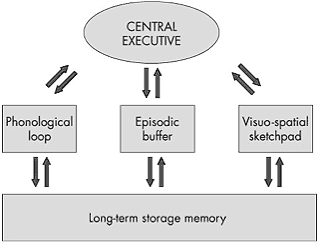 In 2000, Baddeley extended the WM model by adding the episodic buffer, a type of holding tank for all information on a fairly short-term basis. It integrates information from the 2 slave systems (phonological, visual, and spatial) and stores these representations as ‘episodes’. The episodic buffer combines all information into a single episodic representation – it integrates information between visual, spatial, and verbal components of a chronological event, i.e., a story line. Thus rather than conceiving WM as several sub-components having specific functions, Baddeley’s addition of the episodic buffer generates a system that assimilates all stimuli concerning any given event. It could also be the storage component of information not covered by the slave systems, e.g., semantic, musical, etc.,
Amnesiacs who have lost their long-term memory can still store and retrieve from information in STM.
Long-Term Memory
Long-Term Memory (LTM) holds unlimited amounts of information indeterminately. Even though no one can remember every minute detail of every moment throughout a lifetime, it is generally believed that LTM stores all meaningful episodic events, i.e., those that have received adequate attention, have been sufficiently rehearsed, and have been attributed semantic properties.
So why do you not remember what you ate for breakfast December 20 of 2002? Even though LTM is good at integrating and synthesizing information, it is less able to keep smaller bits of information distinct from each other. Recall of any given event is based on its perceived importance and rehearsal. So, while you may not remember your breakfast on a non-descript day, you are more apt to remember that which you consumed on a special holiday (importance). An individual who learns a foreign language as a child, however does not try use it until adulthood, will struggle to remember that which s/he learned. Yet, as soon as a certain amount of studying (rehearsal) occurs, this language competence is restored, or remembered.
The retrieval of information stored in LTM involves incorporating real-world knowledge, from which inferences are drawn and connections are made, again, based on semantic relationships.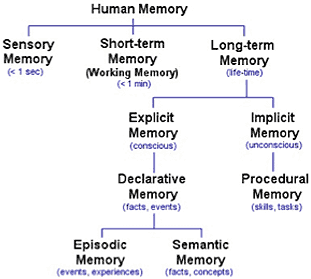
There are two main storage components in LTM:
Explicit memory is conscious awareness of facts and events (Declarative Memory).
- Episodic Memory: the ability to recall personal experiences and events as images; details about past experiences.
- Semantic Memory: the ability to recall personal experiences and events that are meaningful in terms of connections between sources of recurring information which has been learned
Implicit Memory is unconscious and holds procedural information.
- Procedural Memory: the ability to remember strategies in task performance as sequential events or as sets of stimulus-responses.
Let’s look at a few of the more prominent studies in memory:
Word Order over Meaning
Sachs (1967) showed that in memory recall tasks, word meaning is retained over word order. Sachs tested participants’ ability to recognize the word order of four different sentences in which each was presented with varying degrees of intervening syllables. Participants were able to recall word order successfully when there were few intervening syllables. However, he found a correspondence between longer the gaps, created by the increase of intervening syllables, and a decrease in recall of word order. Interestingly, participants showed a significant sensitivity to changes in semantic content.
Sentence (1) was embedded in a story.
(1) He sent a letter about it to Galileo, a great Italian scientist.
Participants were then tested on their ability to distinguish from (1) from (2) – (4).
(2) He sent Galileo, a great scientist, a letter about it. (formal word order variation)
(3) A letter about it was sent to Galileo, a great Italian scientist. (syntactic variation)
(4) Galileo, the great Italian scientist, sent him a letter about it. (semantic variation)
Subjects were asked to focus on word-order differences. Their ability to detect changes in word order rapidly declined in correspondence to length of time delays. Eventually, the distinction in word order was completely lost. However, the shift in meaning between (1) and (4) was recalled even after the longest time lapse.
Context
Bransofrd and Johnson (1973) showed that when stories were not contextualized by prior knowledge, subjects remembered 3.6 ideas out of 14. When stories were contextualized, 8 ideas were recalled out of 14.
Presence vs. Absence
Kaup and Zwaan found that when a concept is present in the utterance (1), it is recalled after delay as opposed to an utterance in which the item referred to is not present (2). Here the concept refers to the pink dress.
(1) Vlad was relieved that Agnes was wearing her pink dress.
(2) Vlad was relieved that Agnes was not wearing her pink dress.
In (1), Agnes is wearing her pink dress, thus the concept is present, thus recall rates were higher then when Agnes decides not to wear the pink dress (2).
Phonological Similarity Effect
Larsen, Baddeley and Andrade (2000) found that similar word recall was 25% slower than dissimilar recall. When participants were asked to serially recall a word list, they performed better when words were phonologically dissimilar.
When stimuli were phonologically similar, the task was more difficult, e.g., knee, he, lee, she, me is more difficult than odd, shy, up, bay, hoe.
For more reading on this subject, click here!
Return to Tutorials: Psycholinguistics