There is a lot more to a syntax tree than meets the eye. Different professors may focus on different aspects of tree structures depending on the amount of class time devoted to the subject and the level of analysis. Most introduction classes do not discuss X Bar Theory. Accordingly the syntax trees in this section are written as the simplest structures that are most commonly seen in text books. However, in the case that your professor draws trees with more detail, here are some of the variations you may see.
Variations on an NP
The most basic NP does not display a detailed structure of the phrase.
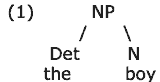
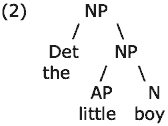
In (1) we do not see the possibility of adding anything to the N boy. However, if N becomes NP we create another NP which will dominate the adjective and head noun yet still maintains the sister relationship between the Det and N.
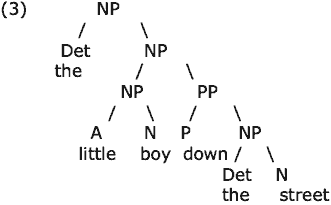
This structure also gives us the possibility of adding an adjunct such as the PP down the street. We maintain the relationship of sisterhood between the Det and the NP, the relationship of sisterhood between the A and N, plus we have added a PP which modifies the entire NP and is adjoined as an adjunct.
In (4) we have now added the possibility of expanding our AP in the event that we want to modify it with an adverb, i.e., very little.
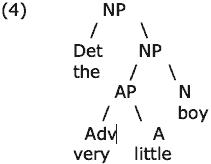
Now we have a sister relationship between the adjective phrase which modifies the noun, as well as between the adverb very which modifies the adjective little.
Variations on a VP
Verb phrases are a little more tricky in that it is necessary to understand the relationship the VP has to its NP complements and adjuncts. Keep in mind that there are three types of verbs: transitive, intransitive, and ditransitive.
Transitive verbs require an NP direct object complement.
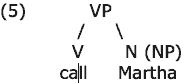
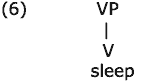
The VP tree must show the sister relationship between V and N (NP). Intransitive verbs will never have a direct object. They will look like this:
Ditransitive verbs either require or are most commonly accompanied by two objects, one direct and one indirect. The relationship of the direct object to the verb is the same as (5). Indirect objects can be attached to the V along with the NP (ternary branching).
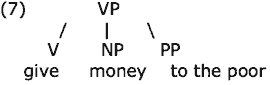
This shows that the verb requires a sister relationship with both objects. Sometimes the indirect object is optional.
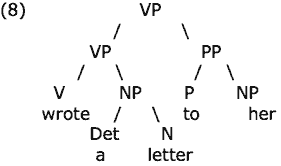
In (8) the PP is adjoined to the VP thus modifying the entire verb phrase wrote a letter. The NP is still attached to the V as a sister.
Lastly, it is important to understand the nature of auxiliary and modal verbs (aux). The simplest trees show aux tucked in between NP and VP.
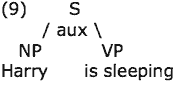
For the formation of yes/no questions, aux will move above the S, forming a new S.
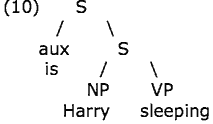
Another common, more detailed structure of aux is seen in (11). Here aux is placed in the specifier position of VP which allows recursion (repetition) of aux in the case that there are several auxiliary or modal verbs.
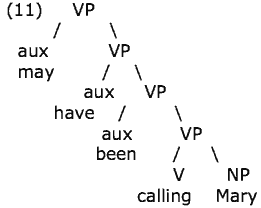
Regardless of how detailed your trees may be, it is important to understand the difference between sisters (complements) and adjuncts and how they are adjoined to the phrases they modify.


